
eNPS Explained: How to Measure and Actually Improve Employee Loyalty
June 17, 2026
Employee Net Promoter Score — or eNPS — is one of the most underused metrics in HR. Simple to deploy, instantly actionable, and surprisingly predictive of business outcomes, it gives you a direct line into how your people truly feel about working at your company. Yet most organizations either skip it entirely or run it once a year and wonder why the data never seems to move the needle. This guide shows you exactly what eNPS is, why it matters far more than most leaders realize, and how to use it to build a place people genuinely want to work.
What Is eNPS?
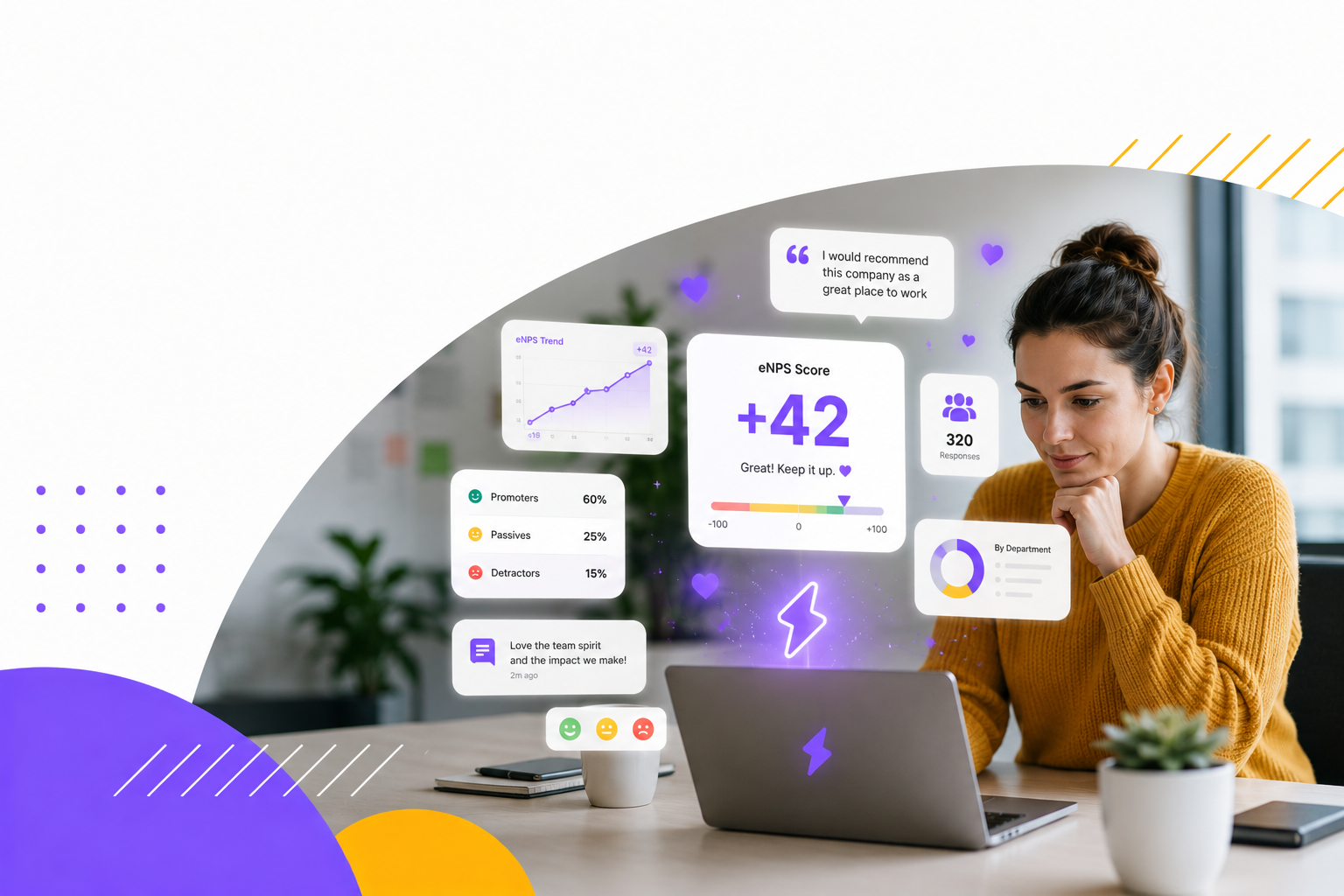
eNPS is borrowed directly from customer experience. Where the classic NPS asks customers how likely they are to recommend a product, eNPS turns that question inward: How likely are you to recommend this company as a place to work? Employees answer on a scale of 0 to 10 and fall into three groups:
- Promoters (9–10) — Enthusiastic advocates who love working at your company and recommend it without hesitation.
- Passives (7–8) — Satisfied but not enthusiastic. Comfortable today, easily persuaded by a better offer tomorrow.
- Detractors (0–6) — Unhappy employees who may actively spread negative sentiment about your company, internally and externally.
The score is calculated by subtracting the percentage of Detractors from the percentage of Promoters, giving you a number from −100 to +100. Above 0 is acceptable, above 20 is good, and above 50 is exceptional.
Why eNPS Matters More Than You Think
Most companies track employee satisfaction — but satisfaction is not the same as loyalty. A satisfied employee is comfortable, not actively unhappy, but not especially energized either. They are fine. And fine is a fragile state. eNPS measures something much harder to fake: advocacy. Would your employees put their own reputation on the line to recommend your company? That requires genuine enthusiasm, not just the absence of complaints.
Research consistently shows that high eNPS correlates with:
- Lower voluntary turnover — Promoters are significantly less likely to leave, reducing recruiting and training costs.
- Higher productivity — Engaged employees go beyond their job description, contributing ideas and effort that passives rarely offer.
- Stronger employer brand — Your people are your best recruiters. High-eNPS companies attract better talent without spending more on job boards.
- Better customer outcomes — Engaged employees deliver better service, which translates directly into customer satisfaction and revenue.
The cost of ignoring eNPS is real. Replacing a single employee typically costs between 50% and 200% of their annual salary. If your score is in negative territory, you are likely losing people faster than you realize.
How to Run an eNPS Survey Effectively
- Keep it short. One core question, one optional open-ended follow-up asking why. That is all. Survey fatigue is real — adding more questions reduces response rates and candor.
- Run it regularly. Quarterly is the standard; monthly pulse checks are even more powerful. Annual-only data is too stale to act on.
- Guarantee anonymity. If employees fear their response can be traced back to them, they will self-censor. True anonymity is non-negotiable for honest data.
- Close the feedback loop. Share results with your teams and explain what you are doing about low scores. Nothing kills trust faster than asking for feedback and then going silent.
- Segment your data. An overall eNPS of +30 might hide a team sitting at −20. Break results down by department, manager, and tenure. That is where the real insight lives.
The Most Common eNPS Mistakes
- Treating the number as the goal. eNPS should start conversations, not end them. When leaders optimize for the metric rather than the culture behind it, the metric becomes worthless.
- Measuring only once a year. Leadership changes, team restructures, and workload spikes can all shift eNPS within weeks. Annual surveys cannot capture this.
- Collecting feedback without acting on it. If employees complete a survey and see no visible change, response rates for the next survey will drop — and the data you do get will be less honest.
- Tying manager bonuses to team eNPS. This creates incentives to pressure employees into giving higher scores, corrupting the data entirely.
How to Actually Improve Your eNPS
- Build a culture of recognition. Employees who feel seen and appreciated are far more likely to become Promoters. Consistent peer recognition and micro-feedback are among the highest-ROI interventions available to any HR team.
- Invest in your managers. The single biggest driver of employee experience is the direct manager. Low eNPS scores almost always cluster around specific managers — treat that as a development opportunity, not an accusation.
- Create psychological safety. Employees will not recommend a workplace where they fear disagreeing, raising concerns, or admitting mistakes. Build feedback channels that flow in both directions.
- Show a credible path for growth. Promoters see a future at your company. Investing in learning, mentorship, and transparent career paths signals you are committed to your people's development.
eNPS in Practice: A Real-World Example
Consider a mid-size technology company with 150 employees running quarterly eNPS surveys through Kudosky. Their overall score was +18 — decent, but the segmented data revealed one engineering team sitting at −5. Without that granular view, the signal would have been buried in the aggregate.
The HR team analyzed the qualitative follow-up responses and found a consistent theme: engineers felt their contributions were invisible to leadership. The fix was not a salary increase or a new perks program — it was a structured peer recognition initiative through Kudosky's micro-feedback tools. Three months later, that team's eNPS had climbed to +22, and two of the most vocal Detractors had become enthusiastic Promoters who were actively referring candidates.
Start Measuring What Actually Matters
eNPS is not a vanity metric. Used well, it is an early warning system, a cultural audit tool, and a catalyst for the conversations that genuinely improve employee experience. The companies that will win the talent competition over the next decade are not the ones with the flashiest perks — they are the ones that listen continuously and act on what they hear.
Ready to launch your first eNPS pulse and turn feedback into action? Try Kudosky for free at kudosky.app/auth/signup, or book a personalized demo at calendly.com/hello-kudosky/kudosky to see how leading companies use continuous employee feedback to build cultures that perform.