
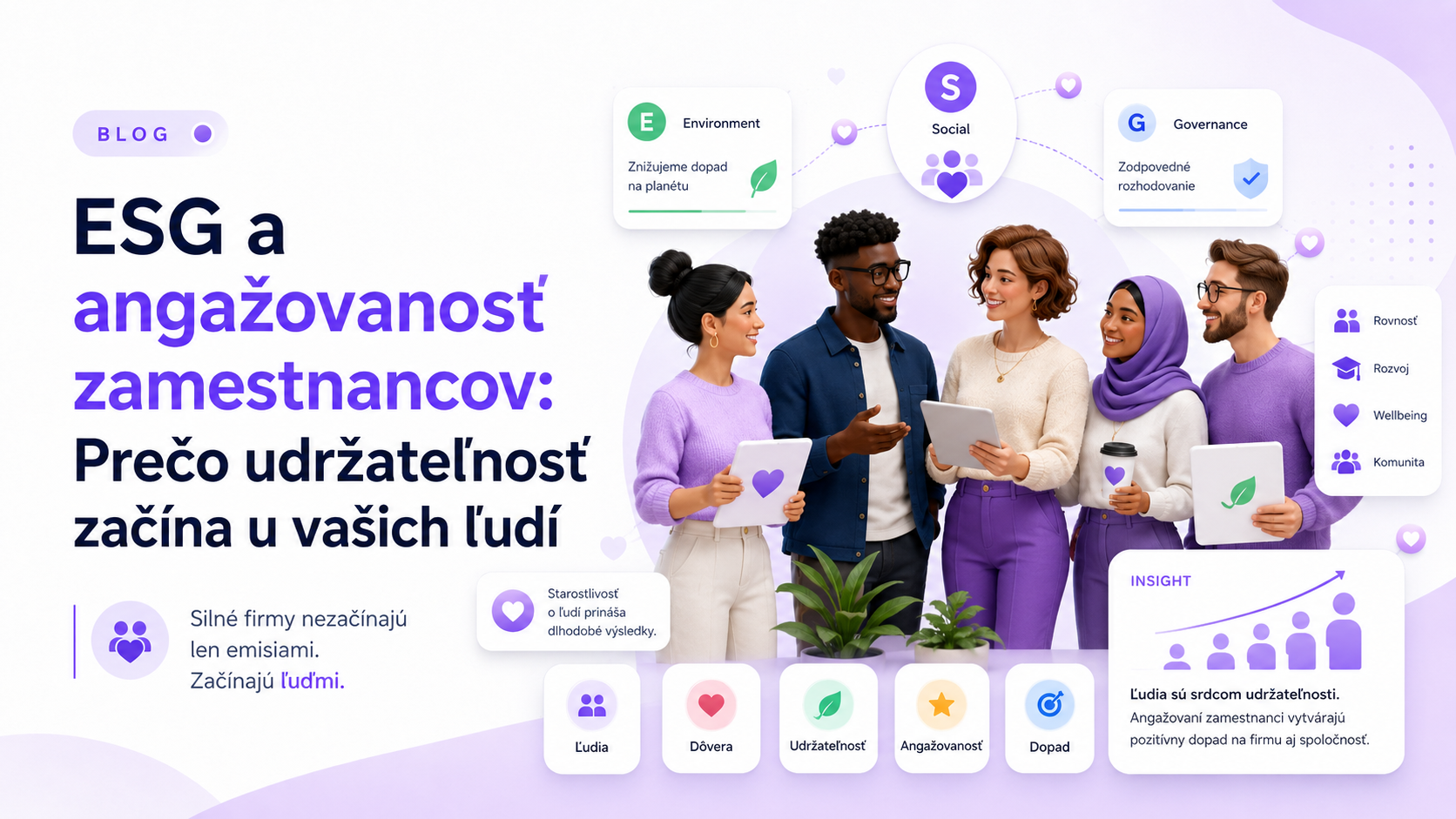
ESG and Employee Engagement: Why Sustainability Starts With Your People
July 15, 2026
ESG reporting has become standard practice for most mid-to-large companies. Boards dedicate significant resources to Environmental metrics and Governance frameworks — but the 'S' for Social often gets reduced to a diversity statistics section and a list of community donations. What is consistently missing is the most powerful social lever available to any organization: the engagement of your own people.
Employee engagement is not just a feel-good HR metric. It is one of the clearest signals of how a company actually treats its people — and therefore a direct measure of your Social ESG performance. Companies that invest in genuine engagement are not just building happier workplaces; they are building more sustainable, resilient businesses.
What the 'S' in ESG Really Means for Employers
The Social pillar of ESG encompasses fair wages, diversity and inclusion, health and safety, labor rights, community impact, and — increasingly — employee well-being and engagement. Investors, regulators, and customers are no longer satisfied with token gestures. They want evidence that your company creates a healthy, inclusive environment where people genuinely want to work and grow.
The European Corporate Sustainability Reporting Directive (CSRD) now requires large companies to disclose detailed data on workforce conditions, including engagement, turnover, and well-being indicators. For thousands of organizations across Europe, this is no longer optional — it is a compliance requirement.
The Link Between Employee Engagement and ESG Performance
Research consistently shows that highly engaged workforces outperform their peers across nearly every business metric. But the connection to ESG runs even deeper:
- Engaged employees are more likely to champion environmental and social initiatives within the organization.
- Low engagement correlates with higher voluntary turnover, which increases the carbon footprint of recruitment, onboarding, and training cycles.
- Psychologically safe and engaged employees surface ethical concerns early — a critical safeguard for Governance.
- Companies with strong engagement scores attract ESG-focused investors, who increasingly treat people practices as a proxy for long-term risk management.
How Engaged Employees Drive Sustainable Business Outcomes
Consider employee engagement not just as an HR objective, but as a business sustainability strategy. Here is how it plays out in practice:
When people feel recognized and valued, they stay longer. High retention dramatically reduces the economic and environmental cost of perpetual hiring cycles. When employees feel psychologically safe, they surface problems before they escalate — whether it is a safety issue, a compliance risk, or a product defect. And when your workforce is genuinely aligned with your company's values, your ESG commitments stop being a PR exercise and start being a lived organizational reality.
Practical Steps to Connect ESG with Your People Strategy
Many companies run ESG initiatives and employee engagement programs in parallel, disconnected silos. Bridging these worlds requires intentional integration:
- Include engagement data in your ESG reporting — engagement scores, voluntary turnover rates, and feedback participation rates belong alongside your environmental metrics.
- Replace annual surveys with continuous listening tools to maintain a real-time pulse on employee sentiment across the entire workforce.
- Recognize employees who actively champion sustainability initiatives — peer recognition programs reinforce ESG-aligned behaviors far more effectively than top-down communications.
- Train managers to connect individual team goals with the company's broader social mission, so every employee understands how their daily work contributes to something larger.
- Set measurable people-centric ESG goals — such as reducing voluntary turnover by 15% or achieving 80% monthly feedback participation — and report on them publicly in your annual disclosure.
Measuring Social Impact From the Inside Out
Social metrics are often the hardest component of ESG to quantify — but the data exists within your organization. Employee Net Promoter Score (eNPS), participation rates in peer recognition programs, manager effectiveness ratings, and feedback frequency are all reliable indicators of the health of your organizational culture.
Modern engagement platforms make it possible to collect this data continuously, surface trends through AI-powered analytics, and present it in a format ready for ESG disclosure. Instead of scrambling to compile social metrics at year-end, you have a living dashboard of your people practices — updated in real time.
The Business Case Is Clear
Companies with strong ESG profiles attract better talent, retain it longer, and build reputations that compound over time. But the shortcut many companies miss is this: you cannot fake the 'S.' Employees know when engagement programs are performative, and so do the investors and analysts who increasingly scrutinize people data during due diligence.
The organizations that will lead on ESG in the coming decade are those that treat employee engagement as a genuine strategic priority — not a line item on the annual survey budget.
Ready to Put Your People at the Center of Your ESG Strategy?
Kudosky is the employee engagement platform built for human-first companies. With continuous micro-feedback, AI-powered insights, and peer recognition tools, Kudosky gives you the data you need to make your Social ESG reporting meaningful — and your workplace genuinely worth working in.
Start for free at kudosky.app/auth/signup or book a personalized demo at calendly.com/hello-kudosky/kudosky.